
The Cost of Getting It Wrong: Why Case Value Often Comes Down to How Clearly It's Presented
The Cost of Getting It Wrong: Why Case Value Often Comes Down to How Clearly It's Presented
Two attorneys can hold the exact same file — the same medical records, the same liability facts, the same damages — and walk away with very different outcomes. The difference is rarely the strength of the underlying case. It's how clearly that case was communicated to the person who had to decide it: a mediator, an adjuster, or twelve strangers in a jury box.
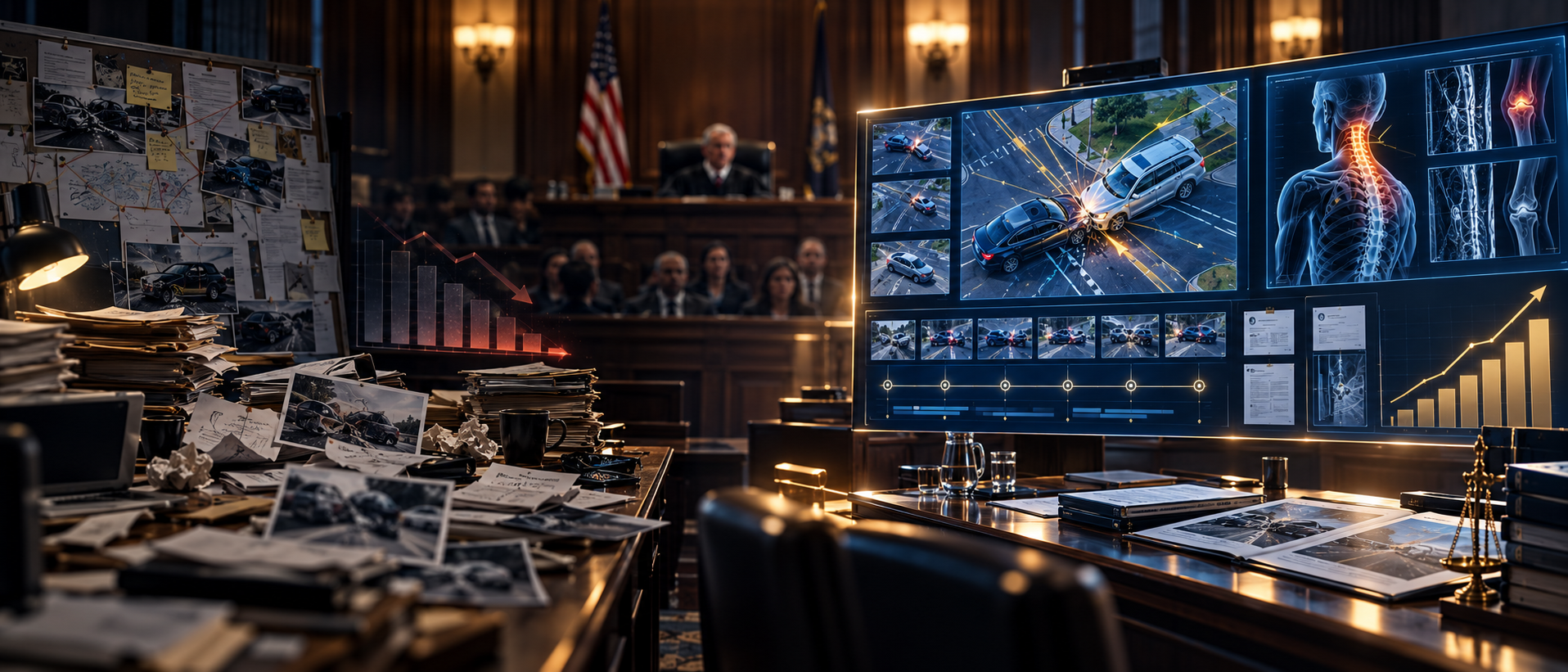
This is the quiet truth behind litigation graphics. They don't manufacture case values. They protect it — by making sure the strength of a case actually reaches the people evaluating it, instead of getting lost in medical terminology, dense records, or an argument that's hard to follow.
Complexity Is the Enemy of Case Value
Every case has a moment where its strongest facts risk becoming its weakest presentation. A causation argument that depends on understanding how a spinal injury actually occurred. A liability theory that hinges on the layout of a property no one in the room has seen. A damages narrative spread across three years of medical records that no adjuster has time to read in full.
Left as text and testimony alone, these facts ask a lot of the person on the other side of the table — attention, patience, and a working knowledge of things they were never trained in. Every one of those demands is a place where your case's true value can quietly leak away, not because the facts were weak, but because they were hard to absorb.
Demonstrative evidence closes that gap. A well-built medical illustration, timeline, or animation doesn't change what happened — it removes the friction between what happened and whether the decision-maker actually understands it.
Where This Shows Up Most: Mediation
Trial gets the attention, but most cases are decided at the mediation table, often well before a courtroom is ever booked. This is where clear, credible visual evidence tends to do the most work — because a mediator or adjuster is forming a value judgment in real time, often based on limited exposure to the file.
A sharp injury visualization, a hyperlinked timeline showing the true arc of treatment, or a short reconstruction animation can shift that judgment in a single session — sometimes more effectively than another round of written correspondence. For firms handling mediation regularly, including here in Grand Rapids, investing in strong visual presentation at this stage often pays for itself many times over in the final settlement number.
Why the Standard Has to Be Accuracy, Not Just Polish
It's worth being direct about this: a demonstrative that looks impressive but isn't tightly tied to the evidentiary record can do real damage. Opposing counsel's first move is often to test whether an exhibit holds up — where a measurement came from, whether an illustration matches the actual imaging, whether an animation reflects the expert's real conclusions rather than an artistic guess.
The exhibits that hold up, and that actually move a case forward, share the same traits every time:
Built directly from the record — medical imaging, scene data, discovery documents — not generic templates
Reviewed with your expert before it's ever shown to the other side
Clear enough to explain in one sentence, no matter how complex the underlying science
Consistent with testimony, so nothing in the visual overstates what the evidence actually supports
This is the difference between a graphic that helps your case and one that quietly becomes a liability.
Why Predictable Cost Matters as Much as Quality
None of this is worth much if it's financially out of reach for anything but your largest files. That's the practical case for flat-rate litigation support: knowing the investment before the work begins means demonstratives can be planned into a case from the earliest stages — often from the demand letter forward — rather than reserved for the rare case where an open-ended invoice feels justified.
For firms managing a full caseload, that predictability is often what makes the difference between using professional-grade visual evidence occasionally and using it as a standard part of how every serious case is built.
What This Looks Like in Practice
A colorized CT overlay that turns a scan only a radiologist could read into something an adjuster understands in ten seconds
A hyperlinked timeline that lets a mediator click straight from a milestone to the medical record behind it, instead of taking your word for it
An accident reconstruction animation that shows, rather than argues, how a collision happened
A 3D-printed model of an actual fracture, sitting on the table during a settlement conference
None of these replace the strength of your case. They make sure that strength is actually seen.
The Bottom Line
Case value isn't only built in discovery and depositions — it's protected, or lost, in how clearly that work is ultimately presented. The firms that treat demonstrative evidence as a standard part of case strategy, rather than a trial-only expense, tend to see the difference show up consistently: in mediation outcomes, in how seriously the other side takes a demand, and in how much of a case's true value actually reaches the people deciding it.
Help Your Case Evidence Make a Clearer Impression
Strong evidence deserves a clear presentation. Trial Template creates custom litigation graphics, medical illustrations, accident reconstruction animations, and timelines to help attorneys explain complex facts during mediation and trial.
Explore our litigation graphics services to find the right visual tools for your case.