
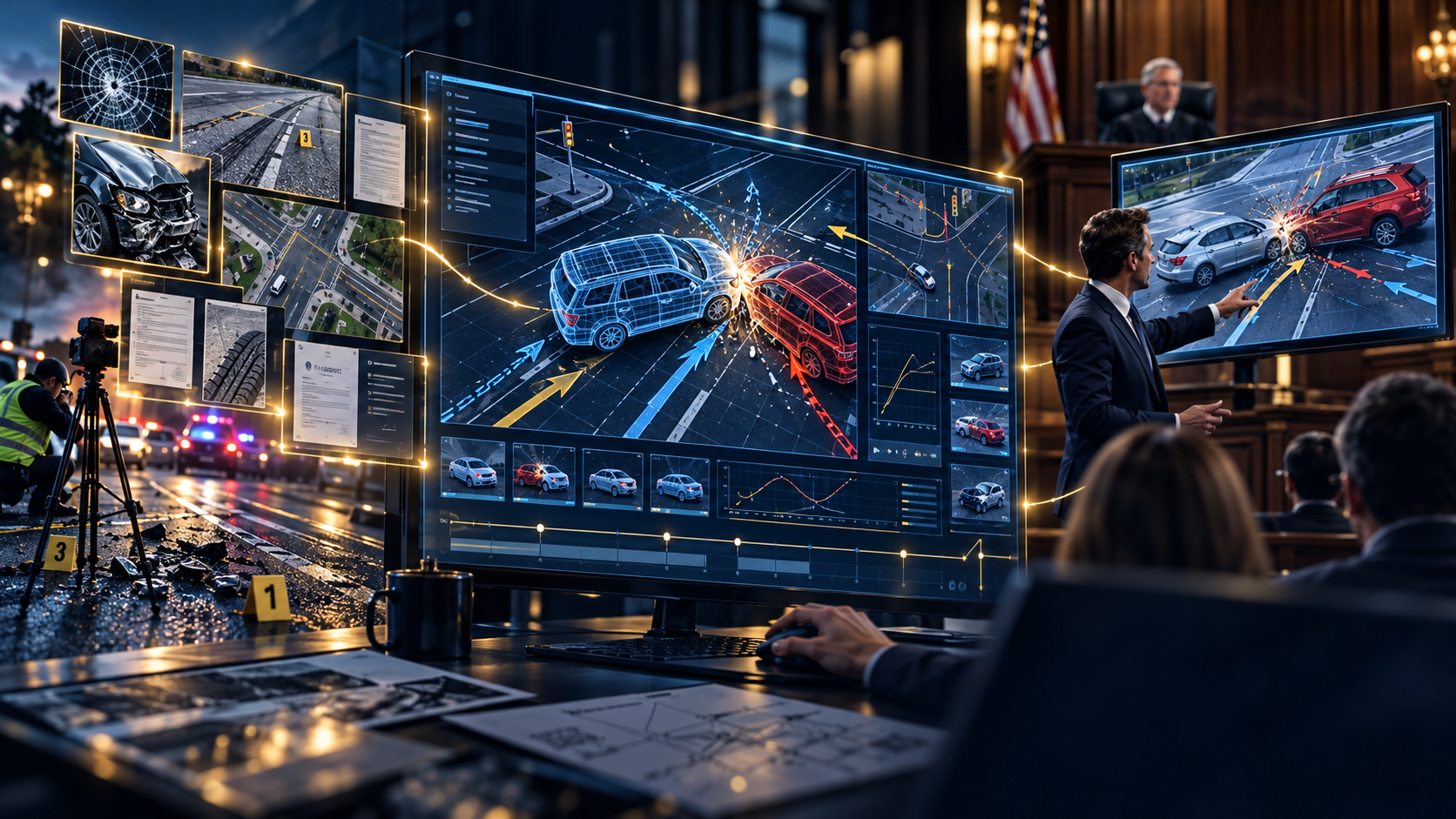
From Collision to Courtroom: How Accident Reconstruction Animation Actually Gets Made
From Collision to Courtroom: How Accident Reconstruction Animation Actually Gets Made
A car accident lasts maybe three seconds. A jury gets one shot to understand it, months or years later, sitting in a courtroom with nothing but photos, a police report, and two conflicting stories. That gap — between what actually happened in three seconds and what a jury can picture from paperwork — is exactly where accident reconstruction animation earns its place in litigation.But most attorneys never see how one of these animations actually comes together. They see the finished product in a demo, or they don't think about it until a defense expert challenges its accuracy on cross. Understanding the process — and where things typically go wrong — makes it a lot easier to know what to ask for, and what to ask a vendor about, before you commission one.
Step One: The Animation Is Only as Good as the Data Behind It
Every credible accident reconstruction animation starts the same way: with evidence, not imagination. That means scene measurements, police reports, vehicle damage data, black box (EDR) downloads, witness statements, and often a site visit or drone/LiDAR scan of the actual location. Skip this step, or work from assumptions instead of data, and you end up with an animation that looks convincing but collapses the moment opposing counsel asks how a specific detail was determined.
This is the single biggest thing separating defensible litigation graphics from cinematic guesswork: everything shown on screen should trace back to a document, a measurement, or an expert's calculation. If it can't, it probably shouldn't be in the animation.
Step Two: An Expert Builds the Physics Before Anyone Touches the Animation Software
Before a single frame is animated, an accident reconstructionist typically works out vehicle speeds, points of impact, and sequence of events using physics and the collected evidence. The animation team's job isn't to invent what happened — it's to visually represent what the expert has already concluded, accurately and to scale.
This is also why animations built for trial should be developed alongside your expert witness, not handed to them after the fact. A demonstrative that doesn't match the expert's actual testimony is worse than no demonstrative at all — it gives opposing counsel an easy opening.
Step Three: Turning Data Into a Visual Sequence
Once the physical reconstruction is set, the animation team builds the scene — the intersection, the vehicles, the road conditions — to scale, then animates the sequence based on the calculated speeds and trajectories. Good studios keep this stage deliberately restrained: no dramatic camera angles, no slow-motion for effect, no added sound design meant to heighten emotion. The goal is accuracy a judge will admit and a jury will trust, not a movie trailer.
This is where animations for trial differ most from animation in any other industry. Restraint is a feature, not a limitation.
Step Four: Legal Review, Not Just Creative Review
Before an animation is finalized, it should go through your expert for technical accuracy and through litigation counsel for legal defensibility — checking that nothing in the visual implies a conclusion the evidence doesn't fully support. This step is where flat-rate litigation support really shows its value: revisions at this stage shouldn't mean a second invoice, because they're part of getting the exhibit right, not scope creep.
It's Not Just for Car Accidents
While vehicle collisions are the most common use case, the same evidence-first process applies to:
Medical mechanism-of-injury animations — showing how a specific movement or event caused a documented injury
Premises liability reconstructions — recreating a fall, a structural failure, or a hazardous condition to scale
Workplace and industrial incidents — sequencing equipment failures or procedural breakdowns
In every case, the animation is a visual argument that the underlying facts already support — not a substitute for those facts.
Where This Matters Before You Ever See a Jury
Reconstruction animations aren't only for trial. In mediation — including in markets like Grand Rapids, where a large share of injury cases resolve before trial — a clear, evidence-based animation can be the difference between an adjuster seeing a case as "disputed liability" and seeing it as a documented sequence of events. Showing a well-built reconstruction early, sometimes as part of a demand package, often shifts settlement conversations before litigation costs pile up on either side.
What to Ask Before You Commission One
What source data will the animation be built from, and who's verifying it?
Will a qualified reconstructionist or engineer sign off on the physics before animation begins?
Is revision included in the price, or billed separately?
How is pricing structured — flat-rate per exhibit, or open-ended hourly?
What's the realistic turnaround given your trial or mediation date?
Need an Accident Reconstruction Animation for Your Case?
Help your audience understand complex collision evidence with professionally developed trial animations and litigation graphics. Trial Template provides visual presentation solutions designed around case evidence and legal requirements.
Explore our trial animation services to discuss the visual needs of your next case.